
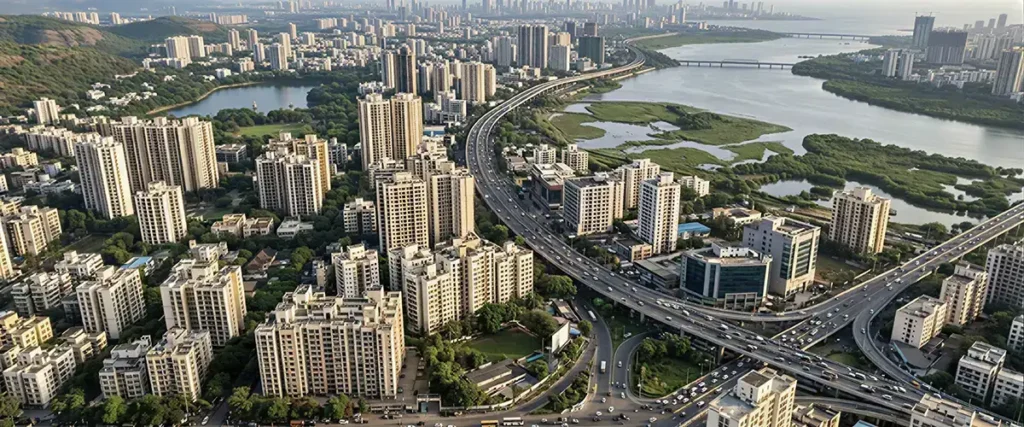
For decades, the narrative of Maharashtra’s property market was dominated by the historical prestige of South Mumbai and the industrial prowess of Pune. However, as we move through 2026, a seismic shift has occurred. Navi Mumbai is no longer just a satellite city or an “alternative” to the island city; it has emerged as a powerhouse of planned urban development, outperforming many established regions in capital appreciation and livability.
Today, the city stands as a beacon of modern town planning, representing a unique segment of the state’s landscape where infrastructure-led growth is a tangible reality rather than a future promise.
The Strategic Blueprint: Planned Urbanism vs. Organic Congestion
What sets this region apart in the state’s residential and commercial hierarchy is its foundational design. Unlike the high-density, often fragmented growth seen in parts of Mumbai or even the rapid suburban sprawl of Pune, Navi Mumbai was built on a framework of organized sectors and wide arterial roads. This grid-based layout has allowed for a level of scalability that older cities struggle to match.
In 2026, this planning has translated into a superior quality of life. Residents enjoy higher ratios of open green spaces and better-managed civic utilities. The presence of Central Park in Kharghar and the sprawling mangrove belts provide an ecological balance that has become a major draw for families seeking a healthier lifestyle away from the industrial smog found in other parts of the state.
Infrastructure as a Value Multiplier
The city’s standing is anchored by massive connectivity milestones that have reached operational maturity this year. The impact of the Mumbai Trans Harbour Link (Atal Setu) has been revolutionary, effectively merging the logistics of the mainland with the commercial heart of the island city. Travel times that once spanned hours have been reduced to mere minutes, positioning nodes like Ulwe and Dronagiri as prime residential corridors for professionals working in South Mumbai.
Furthermore, the Navi Mumbai International Airport (NMIA) has begun phased operations, serving as a massive catalyst for both the residential and hospitality sectors. This “aerocity” influence is driving a surge in Grade-A office spaces, with multinational corporations and Global Capability Centers (GCCs) opting for modern hubs over the high-rent, low-efficiency buildings of older business districts.
Comparative Yields: A Magnet for Diverse Portfolios
When analyzing the return on investment (ROI) across Maharashtra, the city consistently ranks at the top for balanced growth. While central Mumbai offers capital preservation for ultra-luxury portfolios, it often delivers lower rental yields. In contrast, the micro-markets here offer a sweet spot of 3–5% rental yields, coupled with double-digit annual capital appreciation.
The diversity of the market is another strength. Whether it is the premiumization of Seawoods and Vashi, which now rival luxury pockets in the western suburbs, or the high-growth potential of emerging nodes near the Multimodal Corridor, there is an entry point for every budget. The availability of 2 BHK and 3 BHK configurations at competitive price points compared to the staggering rates of the suburbs has ensured that the end-user demand remains robust and immune to speculative bubbles.
The Commercial Renaissance: Beyond a Dormitory City
One of the most significant changes in 2026 is the city’s transition from a “dormitory town” to a self-sustaining economic engine. The IT and Fintech corridors of Airoli and Ghansoli have matured into massive employment hubs. The influx of high-paying jobs has created a ripple effect, boosting the local retail and entertainment industries.
From the upscale dining experiences in Belapur to the modern shopping complexes across the city, the social fabric has evolved to reflect the aspirations of a global workforce. This internal economic strength means the real estate market is no longer solely dependent on the spillover demand from Mumbai; it is now fueled by its own localized growth drivers.
Looking Ahead: The Future of Urban Living
As Maharashtra continues to urbanize, the “Navi Mumbai model” is being studied as a template for future developments. The city’s ability to integrate high-speed transit, sustainable green cover, and modern residential complexes into a cohesive unit makes it a unique asset in the state’s portfolio.
For the modern homebuyer or the forward-thinking investor, the question is no longer about whether to choose this city, but which part of its vibrant landscape offers the best fit for their future. The horizon looks exceptionally bright for this planned marvel.
Partner with Navi Mumbai’s Growth Experts
Are you ready to capitalize on the 2026 property boom? Contact our senior consultants today for a detailed market analysis and exclusive access to high-growth investment opportunities. Your future begins here.
Call: +91 8624040557